
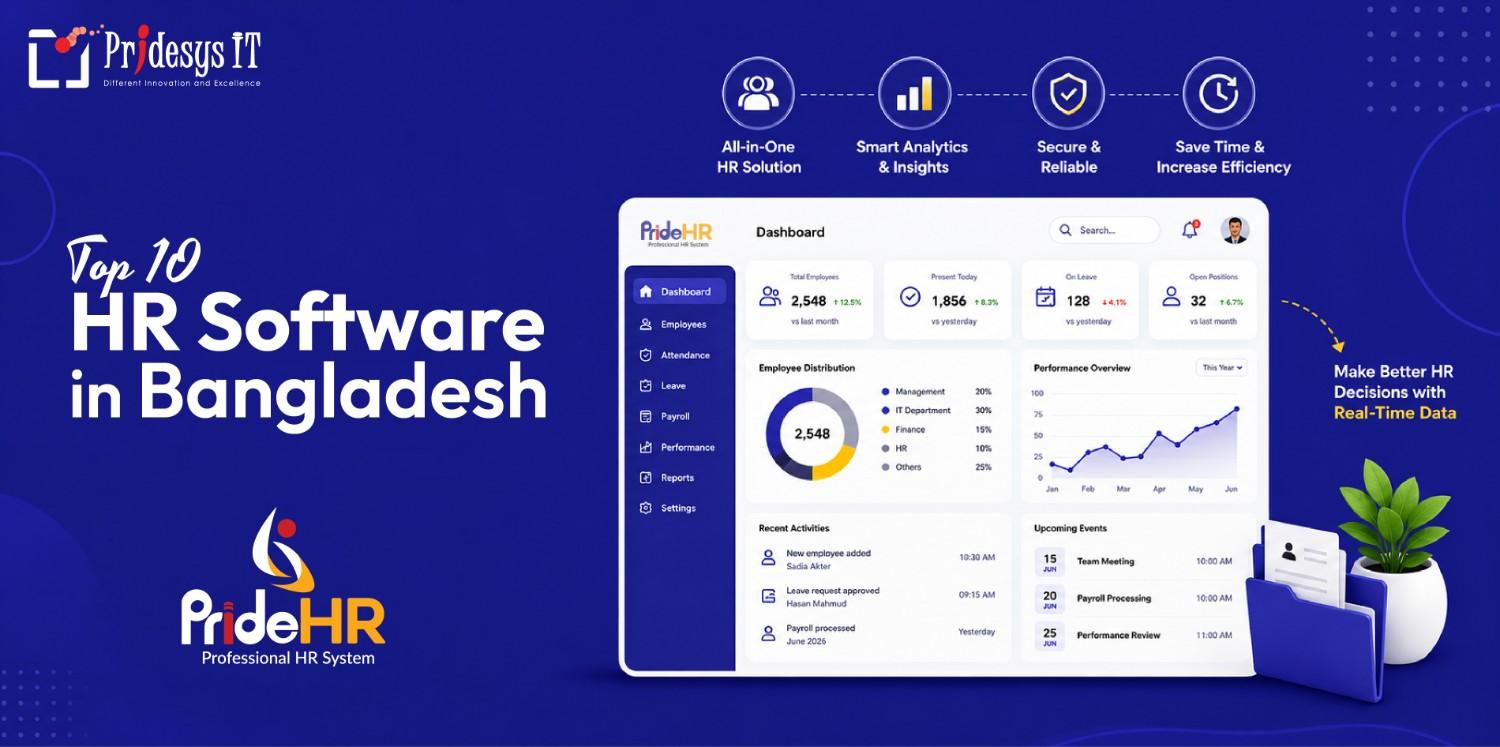
Looking for the top 10 HR software in Bangladesh for 2026? The best overall pick for most businesses is PrideHR by Pridesys IT, followed by Jibika Plexus, PeopleDesk, LinesPay, Smart HRM, XHRM, Roopokar, Apployee, Kormee, and PiHR. Together these ten platforms cover payroll automation, attendance tracking, recruitment, leave management, performance reviews, and NBR-compliant tax and provident fund calculations for companies of every size in Dhaka and across Bangladesh.
This guide breaks down what each platform actually does well, who it fits, and what it costs, so you can shortlist the right one in minutes instead of days.
What Is HR Software?
HR software (also called HRIS, HRM software, or human resource management software) is a digital system that automates the administrative work of managing employees payroll calculation, attendance and leave tracking, recruitment, performance reviews, and compliance reporting. As Wikipedia’s overview of human resource management systems explains, these platforms combine core HR processes with information technology to centralize employee data, replacing spreadsheets, paper registers, and manual salary calculations with a single system that HR teams, managers, and employees can all access.
In Bangladesh specifically, HR software needs to do more than the global default. It has to handle NBR income tax slabs that change with the national budget, provident fund and gratuity calculations under the Bangladesh Labour Act, Eid and festival bonus processing, and often Bengali-language interfaces for staff who are more comfortable working outside English. A generic international HR tool that skips these features usually creates more manual work, not less.
Why Bangladeshi Businesses Need HR Software in 2026
The Real Cost of Manual HR
- Payroll errors damage employee trust and can trigger labour disputes
- Missed compliance deadlines (tax filing, provident fund remittance) invite penalties from regulators
- HR staff buried in admin work have no bandwidth left for hiring, training, or retention, the things that actually grow a business.
Bangladesh-Specific Compliance Pressure
Three areas cause the most manual-HR pain locally:
- NBR tax compliance — Tax slabs and rules are updated with each national budget. Software that doesn’t stay current forces HR teams to manually recalculate deductions every cycle.
- Provident fund and gratuity — Required under the Bangladesh Labour Act for many organizations; calculating this by hand at scale is slow and error-prone.
- Festival bonuses — Eid and other festival allowances are a standard, expected part of compensation; miscalculating or delaying them has a direct impact on morale.
Multi-Location and High-Turnover Realities
Even small Bangladeshi businesses often operate across multiple sites, a retailer with several outlets, a distributor with a warehouse and head office, a factory with satellite units. Combined with the higher staff turnover common in Bangladeshi SMEs, this makes centralized, cloud-based HR visibility a practical necessity rather than a luxury.
What to Look for in HR Software in Bangladesh
| Criteria | Why It Matters |
|---|---|
| Local tax & compliance automation | Non-negotiable — manual configuration for NBR/PF/gratuity defeats the purpose of the software. |
| Ease of use | Most SMEs have no dedicated IT team; the platform must be usable without technical training. |
| Bilingual interface (EN + BN) | Ensures adoption across all employee levels, not just management. |
| Mobile self-service | Employees expect to check payslips, apply for leave, and mark attendance from their phone. |
| Scalability | The platform should grow from 20 employees to 2,000 without a system change. |
| Local support | When payroll breaks during salary week, you need a Bangladesh-based team reachable by phone. |
| Pricing transparency | Clear tiers help you budget instead of negotiating blind. |
Top 10 HR Software in Bangladesh (2026)
1. PrideHR by Pridesys IT — Best Overall HR & Payroll Software
PrideHR is an all-in-one, cloud-based HR and payroll platform built for Bangladeshi organizations, covering the full employee lifecycle from recruitment and onboarding to payroll, attendance, performance management, and reporting in a single system.
Key features:
- Automated payroll with NBR tax, provident fund, and gratuity calculations
- Biometric and mobile attendance integration
- Employee self-service portal (leave, payslips, attendance)
- Recruitment and onboarding automation
- Performance management and KPI tracking
- Real-time HR analytics dashboard
- Bilingual (English + Bengali) interface
Proven results: PrideHR processes salaries for 4M+ employees and manages the work activities of 4M+ professionals across Bangladesh, handling BDT 160+ billion in monthly salary transactions, with support extending to all 64 districts of the country.
Client base: Trusted by 200+ organizations and 70,000+ users across 400+ industries, including manufacturing, RMG, retail, banking, and NGOs, with notable clients such as Ananta Group and Pretty Group.
Pricing: Customized package based on employee count and modules
Contact: sales@pridesys.com | pridesys.com/products/pridehr
Pros:
- End-to-end HR system — no need to stitch together separate tools
- Built specifically for Bangladeshi compliance requirements
- Scales from SME to large enterprise
Cons
- Initial setup and customization takes onboarding time, like most enterprise-grade HRIS platforms
Best for: Companies that want one platform to replace payroll, attendance, recruitment, and performance tools entirely.
2. PeopleDesk by iBOS — Best for Employee Lifecycle Management
PeopleDesk is a cloud-based HR and payroll platform developed by iBOS Limited, used by organizations ranging from startups to banks to manage the employee lifecycle from hiring through retirement.
Key features:
Recruitment and onboarding, attendance and leave tracking
performance monitoring
payroll integration
employee database management
Best for: Small to MId size organizations wanting detailed HR reporting across the full employee lifecycle.
Cons: Some users report a learning curve during initial rollout.
3. Jibika Plexus — Best for Fast Payroll Processing
Built for Bangladesh’s garments and manufacturing sector, Jibika Plexus focuses on fast, reliable payroll processing at scale, along with attendance, compliance reporting, and loan/bonus calculation.
Best for: RMG factories and large-workforce manufacturers that need dependable, high-volume payroll runs.
Cons: Limited third-party software integrations compared to broader HRIS platforms.
4. LinesPay HRM — Best for Workforce Lifecycle & RMG Complianc
LinesPay is a modular HR platform designed for large workforces, particularly RMG factories and industrial units. Its modular design lets HR teams activate only the features they need, payroll, attendance, leave, compliance, and shift/roster management.
Best for: Large industrial employers that need compliance-heavy, RMG-ready HR management with flexible module selection.
Cons: Marketing and brand visibility is lighter than larger competitors, which can make evaluation harder without a direct demo.
5. Smart HRM — Best for Small & Mid-Size Businesses
Smart HRM is a straightforward, budget-friendly platform aimed at small and mid-size businesses that need core payroll, attendance, leave, and performance tracking without enterprise-level complexity.
Best for: Startups and small teams that want an affordable entry point into HR software.
Cons: Lacks advanced reporting and analytics found in higher-tier platforms.
6. XHRM — Best for Comprehensive HR + Finance Integration
XHRM combines HR, attendance, payroll, and financial accounting in a single scalable system, making it a strong choice for growing businesses that want HR and finance data connected rather than siloed.
Best for: Growing SMEs that want HR and accounting integrated in one platform.
Cons: Requires initial training to use the broader feature set effectively.
7. Roopokar — Best for Large Businesses Wanting Online/Offline Flexibility
Roopokar handles payroll, leave, attendance, performance, and employee engagement for large teams, with both online and offline deployment options, useful for sites with inconsistent internet connectivity.
Best for: Large businesses needing HR software that works reliably even with limited internet access.
Cons: Limited integrations with third-party mobile apps.
8. Apployee — Best Lightweight Cloud HR for Small Teams
Apployee is a lightweight, cloud-based platform built for startups and small teams that need essential attendance, leave, payroll, and engagement tools without a heavy feature set to manage.
Best for: Startups that want a simple, low-overhead HR tool.
Cons: Limited advanced modules as the company scales past a small team.
9. Kormee — Best for Performance & Attendance Insights
Kormee focuses on giving managers detailed dashboards into workforce productivity, attendance patterns, and employee engagement, alongside standard payroll and compliance reporting.
Best for: Medium to large businesses that prioritize performance and attendance analytics.
Cons: The interface can feel complex for first-time users
10. PiHR — Best Affordable, Comprehensive HRIS
PiHR delivers end-to-end HR management — payroll, tax automation, attendance, leave, recruitment, and performance tracking, at one of the more accessible price points in the market, starting around Tk. 2,500/month.
Best for: Small enterprises wanting a comprehensive HRIS without a high entry cost.
Cons: Advanced modules may require additional training to use fully.
Comparison Table: Top 10 HR Software in Bangladesh (2026) at a Glance
| Software | Payroll Automation | NBR Tax Compliance | Mobile Self-Service | Performance Management | Bilingual (EN+BN) | Best For | Starting Price |
|---|---|---|---|---|---|---|---|
| PrideHR | ✅ | ✅ | ✅ | ✅ | ✅ | All-in-one HR & payroll | Customized |
| PeopleDesk | ✅ | ✅ | ✅ | ✅ | ✅ | Employee lifecycle | Customized |
| Jibika Plexus | ✅ | ✅ | ⚠️ | ⚠️ | ⚠️ | RMG fast payroll | Customized |
| LinesPay | ✅ | ✅ | ⚠️ | ✅ | ⚠️ | RMG compliance | Customized |
| Smart HRM | ✅ | ⚠️ | ❌ | ❌ | ⚠️ | SMEs & startups | Customized |
| XHRM | ✅ | ✅ | ⚠️ | ✅ | ⚠️ | HR + finance | Customized |
| Roopokar | ✅ | ⚠️ | ❌ | ✅ | ⚠️ | Large, offline-capable | Customized |
| Apployee | ✅ | ⚠️ | ⚠️ | ⚠️ | ⚠️ | Small teams | Customized |
| Kormee | ✅ | ✅ | ✅ | ⚠️ | ⚠️ | Performance analytics | Customized |
| PiHR | ✅ | ✅ | ⚠️ | ⚠️ | ⚠️ | Affordable HRIS | Tk. 2,500/mo |
✅ Full support | ⚠️ Partial support | ❌ Not available
How Much Does HR Software Cost in Bangladesh?
Most vendors price on a per-employee, per-month basis under a cloud subscription model, you pay for what you use, with no server or IT maintenance costs. Expect three general tiers:
- Entry-level: Basic payroll and attendance, suited to businesses under ~50 employees
- Mid-tier: Adds performance management, recruitment, and analytics
- Enterprise: Full HRIS with multi-location support, advanced compliance, and dedicated support
Implementation for cloud platforms is typically fast, with the vendor assisting in data migration and configuration. For most SMEs, the time saved on manual payroll alone covers the subscription cost within the first quarter.
Choosing the Right HR Software for Your Business
Among the top 10 HR software in Bangladesh covered here, there is no single “best” pick for every company, the right choice depends on your company size, industry, and how much compliance complexity you’re dealing with.
- If you want one platform that replaces payroll, attendance, recruitment, and performance tools entirely, with built-in NBR tax, provident fund, and gratuity handling, PrideHR is built for exactly that.
- If your priority is fast payroll processing for a large RMG workforce, Jibika Plexus or LinesPay are stronger fits.
- If you’re a small team or startup on a tight budget, Smart HRM or Apployee will cover the essentials without unnecessary complexity.
- If you want HR and finance data integrated in one system, XHRM is worth evaluating.
Whatever platform you choose, prioritize three things above everything else: local NBR/PF compliance handled automatically, a mobile self-service app your employees will actually use, and a local support team you can reach when payroll week goes wrong. Get those three right, and the rest of the feature list becomes a matter of preference rather than necessity.
For most Bangladeshi businesses from growing SMEs to large enterprises, PrideHR remains the most complete starting point, combining local compliance, scalability, and an all-in-one feature set built specifically for the Bangladesh market.
Frequently Asked Questions (FAQs)
1-What is the best HR software in Bangladesh?
PrideHR by Pridesys IT is widely used as an all-in-one HR and payroll platform in Bangladesh, offering payroll automation, attendance tracking, recruitment, and performance management with built-in NBR tax and provident fund compliance.
2-What is HRIS software and why do businesses in Bangladesh need it?
HRIS (Human Resource Information System) is software that centralizes and automates HR functions, employee records, payroll, attendance, and compliance. Bangladeshi businesses need it because manual HR processes are slow, error-prone, and cannot scale with growing headcount or Bangladesh Labour Act compliance requirements.
3-Can HR software handle Bangladesh-specific tax and payroll rules?
Yes. Platforms built for the Bangladesh market, such as PrideHR, automatically apply current NBR income tax slabs, provident fund contributions, gratuity calculations, and Eid/festival bonus processing, updating as regulations change.
4-How much does HR software cost for a small business in Bangladesh?
Most vendors use a per-employee monthly subscription model, so smaller businesses pay proportionally less. Many platforms, including PiHR, start at a few thousand taka per month, while others like PrideHR offer customized pricing based on company size and required modules.
5-What’s the difference between payroll software and full HR software?
Payroll software only handles salary calculation, tax deductions, and payslips. Full HR software (HRM/HRIS) includes payroll but also covers attendance, leave, recruitment, performance management, and analytics — making it a more complete solution for most growing businesses.
6-How long does it take to implement HR software in Bangladesh?
Cloud-based platforms typically go live within a few days to a couple of weeks, depending on company size and payroll complexity, with the vendor handling data migration and initial configuration.
7-Which HR software is best for RMG and manufacturing companies?
Platforms built for high-volume, compliance-heavy environments — such as PrideHR, Jibika Plexus, and LinesPay, are best suited for RMG and manufacturing companies, offering shift management, bulk payroll processing, and full labour law compliance.
Have questions about which HR software fits your team size and industry? Book a free PrideHR demo and our team will walk you through a setup built for your specific compliance needs.