
Quick Answer
The best ERP software in Bangladesh depends on your industry and size. For garments, textile, manufacturing and most other industries, PrideERP is the main platform, with industry editions such as PrideTex for RMG and PrideBiz for trading. For groups of companies, PrideERP is the main focus, and ZAB ERP and Sunshine ERP are also strong local options. For small businesses on a tight budget, Managerium, Odoo or TallyPrime can be enough. Large international groups often choose SAP Business One or Oracle NetSuite through local partners.
Pridesys IT Ltd develops PrideERP, so you will see us on this list. We judged every vendor against the same criteria, listed each one’s real limitations, and recommended competitors where they fit better. Vendor details come from their public websites and may change, so confirm before you buy.
Quick picks: which ERP fits your business?
| If your business is… | Look at first | Why |
|---|---|---|
| Garment, textile or knit factory | PrideERP (PrideTex edition) | Merchandising, sample, IE, production and garments commercial modules |
| Group of companies or multi-branch | PrideERP, ZAB ERP | Multi-entity consolidation and branch management |
| Mid-size trading, distribution or service | Managerium, PrideBiz | Broad modules, branch and sales management |
| Bangla-first team, small group | Sheba ERP | Bilingual interface and multi-company support |
| Small business, tight budget | Sunshine ERP, TallyPrime, Odoo | Lower entry cost, fixed packages or open-source base |
| Large or international operations | SAP Business One, Oracle NetSuite, Dynamics 365 | Global platforms delivered through local partners |
What is ERP software?
ERP (Enterprise Resource Planning) software is a single business system that connects finance, inventory, purchasing, sales, HR, production and CRM on one database. Everyone works from the same live numbers instead of separate spreadsheets.
In Bangladesh, a good ERP must also handle NBR VAT (Mushak forms such as Mushak 6.3 challan), BDT currency, local payroll rules, Bangla usability and local support. Many global systems need a partner to build these, which affects cost and timeline. For global market context, see Statista’s ERP software market outlook.
How we compared these ERP systems
We used eight criteria. Use the same list to question any vendor, including us.
- Industry fit: built for your industry, or adapted to it?
- VAT/Mushak: is the VAT challan generated automatically at sale, or is it a separate step?
- Year-one cost: license plus implementation, migration, training and support.
- Local support: Bangla training, response time, who answers when the system is down.
- Customization: how much is configuration and how much is paid development.
- Deployment: cloud, on-premise or hybrid, and behaviour during internet outages.
- Data ownership: can you export your data in a usable format if you leave?
- References: a live customer of your size and industry you can call.
ERP software in Bangladesh: comparison table
ERP pricing depends on company size, users, modules and processes, so no vendor can give one fixed figure. This column shows how each vendor prices, not an amount.
| ERP | Type | Best for | How pricing works | Deployment |
|---|---|---|---|---|
| PrideERP (Pridesys) | Local | Groups and multi-industry businesses | Based on company size, users, modules and complexity | Cloud and on-premise |
| ZAB ERP (Orange Solutions) | Local | Groups, multi-branch, manufacturing | Custom quote by scope | Cloud |
| TallyPrime | Global (India) | Accounting-led small business | Varies by edition and users | Desktop, cloud options |
| Sheba ERP (Mysoft Heaven) | Local | Bangla-first teams, multi-company | Quote on request | [verify] |
| Managerium (AKIJ iBOS) | Local | SME to mid-size, ERP+POS+HRM+CRM | Quote on request | Cloud |
| Sunshine ERP (Sunshine IT) | Local | Small and growing businesses | Published tiered packages | Cloud or local server |
| Odoo (via partners) | Global open-source | Customizable SME to mid-size | Varies by scope and partner | Cloud or on-premise |
| SAP Business One | Global | Mid-market and larger | Enterprise-tier, partner-quoted | Cloud or on-premise |
| Oracle NetSuite | Global | Cloud-only, international | Enterprise subscription | Cloud only |
| Microsoft Dynamics 365 | Global | Microsoft-standardized firms | Enterprise subscription | Cloud, on-premise options |
The Top 10 ERP Software in Bangladesh
Each entry uses the same template. Order reflects fit by situation, not an overall score.
1. PrideERP (Pridesys IT Ltd)
- Best for: groups of companies that run several businesses or industries on one platform, from garments and manufacturing to trading, education, telecom, hotels and government, in Bangladesh and abroad
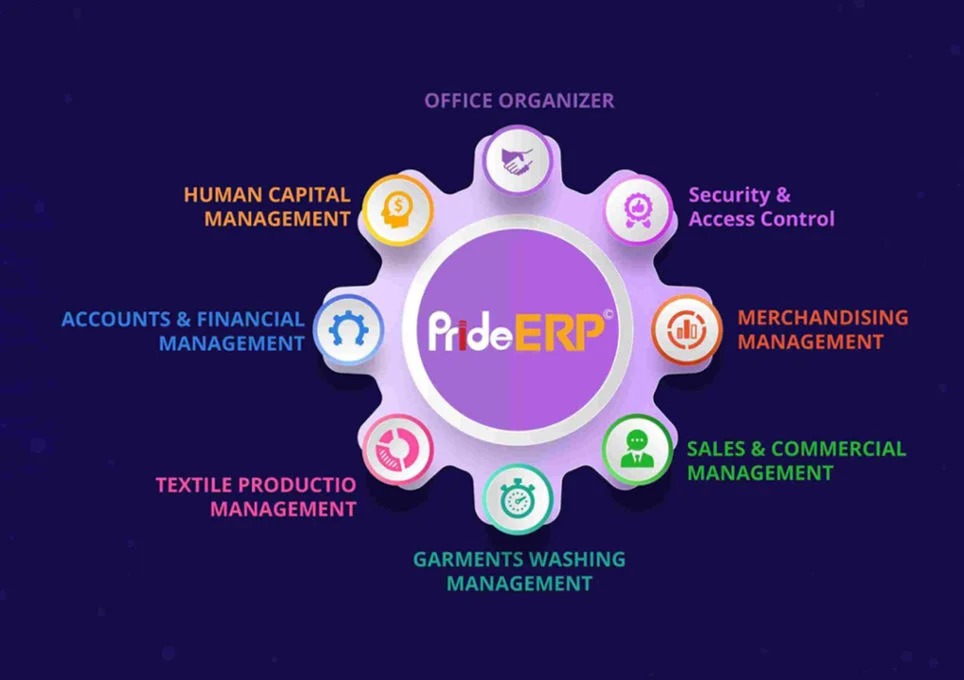
- What it does: PrideERP covers accounts and finance, HR and payroll, purchase, material and inventory, sales and commercial, fixed assets, maintenance, quotation and pre-costing, sample management, merchandising, garments commercial, industrial engineering (IE), garments audit and garments MIS. PrideTex is the garments and textile edition. PrideERP is the main product, and the industry and function editions are included under it: PrideBiz (trading), PrideGov (government), PrideTelco (telecom), PrideEdu (education), PrideHotel (hospitality), PrideHR (HR and payroll), PrideCRM (customer management) and PrideVAT (VAT).
- Price: PrideERP has no fixed price. Cost depends on company size, number of companies in the group, users, modules and process complexity, so we scope each project and give a written quote after a requirements discussion.
- Proof: Ananta Companies – Garments Industry. Implemented PrideERP to streamline production, inventory, merchandising and business reporting. The solution helps improve operational visibility, data management and coordination across departments.
- Support: implementation, training and support come from Pridesys’s own Bangladesh team rather than a reseller.
- Consider: Because PrideERP spans many industries, the right edition and module set matters. Ask for a scoped quote, since PrideERP is built mainly for groups of companies and a very small single-shop business may not need the full system.
2. ZAB ERP (Orange Solutions Ltd)
- Best for: groups of companies and multi-branch businesses that need one consolidated view.
- Per the vendor’s website, ZAB ERP consolidates inventory, sales and financials across branches and entities, includes native VAT handling, and Orange Solutions is ISO 9001:2015 certified and a BASIS member. A lighter edition, ZAB Lite, targets small businesses.
- Consider: it is aimed at growing, complex operations, so very small single location shops may not need the full system. Ask how implementation scopes to your plant or process.
3.TallyPrime
- Best for: accounting-led small businesses that mainly need books, inventory and GST/VAT-style reporting.
- TallyPrime is the current Tally product and replaces the older Tally.ERP 9.
- Consider: it is not a full production or multi-entity ERP. Businesses that outgrow accounting usually move to a full ERP.
4. Sheba ERP (Mysoft Heaven (BD) Ltd.)
- Best for: teams that want a Bangla first interface and multi-company consolidation.
- The vendor lists a bilingual Bangla and English interface, general ledger, stock and supply chain, and HR and payroll through related products.
- Consider: the vendor’s marketing includes AI and analytics claims we could not independently verify. Ask for a live demo of any feature that matters to you.
5. Managerium (AKIJ iBOS)
- Best for: SMEs and mid-size firms wanting ERP, POS, HRM, CRM, accounting and inventory in one cloud platform.
- The vendor positions Managerium as a locally developed all-in-one platform for Bangladeshi businesses.
- Consider: public pricing is limited. Request a written year-one quote and a reference in your sector
6. Sunshine ERP (Sunshine IT)
- Best for: small and growing businesses that want published pricing.
- The vendor’s site lists three tiered packages (Standard, Professional, Enterprise) with hosting, training and SMS integration included at higher tiers.
- Consider: the modules are general-purpose (accounting, inventory, sales, HR, CRM). Industry-specific depth, such as garment production or multi-entity consolidation, may need customization. Ask what customization costs on top of the package.
7. Odoo (via local partners)
- Best for: businesses that want a flexible, open-source platform and will vet an implementation partner carefully.
- Odoo is an international modular ERP. Bangladesh-specific work such as NBR VAT and Mushak forms, BDT handling and local payroll is typically built by the implementation partner, so quality varies by partner.
- Consider: you are choosing both software and a partner. Ask for a live Mushak 6.3 demonstration on your own data and a written scope and cost.
8. SAP Business One (via local partners)
- Best for: established mid-market and larger businesses that want a global standard with local delivery.
- SAP Business One is delivered in Bangladesh by certified partners and supports cloud or on-premise deployment.
- Consider: structure and control come with higher cost and longer configuration for unusual local workflows. Ask for the full multi-year cost, not just the license.
9. Oracle NetSuite (via local partners)
- Best for: cloud-only businesses, especially with international operations.
- NetSuite is cloud-native with no on-premise option and is available through local partners.
- Consider: because it is cloud-only, ask how the partner handles internet and provider outages for other Bangladeshi clients. Expect enterprise-tier pricing.
10. Microsoft Dynamics 365
- Best for: companies already standardized on Microsoft 365 that want ERP and CRM together.
- Dynamics 365 combines finance, supply chain, project operations and Business Central with deep Microsoft integration.
- Consider: many implementation partners serve Bangladesh remotely. Confirm Bangla support, time-zone coverage and response times before signing.
Why PrideERP fits groups of companies and multi-industry businesses
PrideERP is Pridesys’s main product, built mainly for groups of companies that run several businesses or industries under one ownership. It serves every industry through editions that sit inside the same platform, and it also works for organizations outside Bangladesh Like Jordan, Thailand etc. You do not buy separate systems: the editions below are included under PrideERP and share one database.

| Edition | Built for |
|---|---|
| PrideTex | Garments, textile and apparel (merchandising, sample, IE, production, garments commercial, MIS) |
| PrideBiz | Trading companies |
| PrideGov | Government and public-sector organizations |
| PrideTelco | Telecom |
| PrideEdu | Education institutions |
| PrideHotel | Hotels and hospitality |
| PrideHR | HR and payroll |
| PrideCRM | Customer relationship management |
| PrideVAT | VAT and NBR compliance |
What this gives you:
- One platform for the whole business: finance, inventory, purchase, sales, HR, CRM and VAT run on the same data across every company in your group, so you can start with the edition you need and add others as you grow.
- Local VAT compliance: PrideERP and PrideVAT support VAT compliance by generating Mushak 6.3 and related VAT reports.
- Direct local support: Pridesys’s own team handles implementation, training and support.
- Industry reach: apparel, textile, washing, embroidery and printing, footwear, chemicals, food and beverage, healthcare, education, telecom, insurance, hospitality and public sector. International use: PrideERP also runs outside Bangladesh Like Jordan, Thailand etc.
Tell us your group structure and industries, and we will scope the right editions. Ask for a live demo using your own data, and use the same eight criteria above to compare us with any vendor.
How much does ERP software cost in Bangladesh?
ERP cost has more parts than the license or monthly fee. Year-one cost usually includes:
| Cost item | What to ask |
|---|---|
| License or subscription | What is included, how many users and modules? |
| Implementation and configuration | Fixed fee or hourly? What is out of scope? |
| Data migration | What do you migrate, and what must we re-enter by hand? |
| Training | One-time or per new employee? In Bangla? |
| Annual support and maintenance | Itemized in writing, not a vague percentage. |
| Customization | Rate card and delivery timeline. |
Year-one cost = license + implementation + migration + training + support (+ customization). A system with a low monthly fee but heavy customization can cost more than a higher-priced system that fits out of the box.
Why there is no single price: ERP price depends on company size, number of companies and branches, users, modules, integrations, customization and how complex your processes are. Two companies in the same industry can pay very different amounts. Ask every vendor for a written breakdown.
Local VAT and Mushak 6.3: what to verify
Every vendor says “NBR compliant.” Ask four precise questions:
- Does the Mushak 6.3 VAT challan generate automatically when a sale is posted?
- Are purchase and sales VAT books (Mushak 9.1 returns data) produced from the same transactions?
- Is VAT built into the core system or sold as a separate module?
- Can you see it work on your own data in a live demo?
See the NBR VAT compliance guide for official requirements
How to choose the right ERP in Bangladesh

- Write down your 10 most important processes (order to cash, purchase to pay, production, payroll, VAT). An ERP cannot automate what is undocumented.
- Set a year-one budget, not a license budget.
- Shortlist three vendors using the quick-pick table.
- Demo on your data: bring a real order, a real month of stock movement, a real VAT sale.
- Call references of your size and industry that have been live for six months or more.
- Ask the hard questions: outage behaviour, data export format and cost, migration timeline in weeks, support SLA.
- Get everything in writing and ignore artificial urgency.
Is your business ready for ERP?
ERP projects fail more often from preparation gaps than from software. You are ready if most of these are true:
- A senior leader owns the project personally.
- Your processes are written down, not just known by one person.
- Your product, customer and stock data is consistent.
- Your staff were told early and trained in their language.
- Your budget covers implementation and training, not only the license.
If most are not true yet, fix them first. The same gaps will sink any system.
Frequently asked questions (FAQs):
1-Which is the best ERP software in Bangladesh?
There is no single best ERP. The best fit depends on industry, size and budget. Garments, manufacturing and many other firms shortlist PrideERP (with editions such as PrideTex and PrideBiz), groups of companies look at PrideERP, ZAB ERP, small businesses consider Sunshine ERP, Odoo or TallyPrime, and large international firms consider SAP Business One or NetSuite.
2-How much does ERP software cost in Bangladesh?
ERP cost has no fixed figure: it depends on company size, number of users and companies, modules, customization and process complexity. Year-one cost includes license, implementation, migration, training and support. Ask each vendor for a written, itemized quote based on your own requirements.
3-Which ERP is best for garments and RMG factories?
Choose an ERP with merchandising, sample management, costing, line planning, IE, production tracking, LC handling and garments MIS built in. PrideTex, the garments and textile edition of Pridesys. Compare at least two vendors using a live demo on your own order data.
4-Is Odoo or a local ERP better in Bangladesh?
Odoo offers flexibility but depends on a partner for NBR VAT, Mushak and local payroll. Local ERPs usually include these out of the box. Choose Odoo if you need heavy customization and have a strong partner. Choose a local ERP for faster compliance and Bangla support.
5-Does ERP software support NBR VAT and Mushak 6.3?
Many Bangladeshi ERPs do, but implementation differs. Ask whether the Mushak 6.3 challan generates automatically when a sale is posted, and see it live on your data. International ERPs usually need local customization by a partner.
6-How long does ERP implementation take in Bangladesh?
Small deployments can take weeks. Mid-size projects often take three to six months, and complex multi-entity or factory rollouts can take longer. Timelines depend on data quality, customization and staff readiness. Ask for a week-by-week plan tied to your data volume.
7-Cloud ERP or on-premise ERP: which is better?
Cloud ERP gives remote access and lower setup cost, but depends on internet reliability. On-premise gives control but needs servers, power and IT staff. Hybrid options exist. Ask every vendor what happens to transactions during an internet outage.
8-Can I switch ERP vendors later and keep my data?
Ask before signing: is the data yours, in what format can you export it, and what does export cost? A confident vendor answers directly and in writing.
9-Is MS Excel an ERP?
No. Excel is a spreadsheet. ERP integrates finance, inventory, HR, production and CRM on one database with controls, audit trails and real-time reporting.
10-What modules should an ERP have?
Core modules are accounting and finance, inventory, purchase, sales, HR and payroll, and CRM. Manufacturers add production planning and costing. Garments factories add merchandising, sample, IE, bundle tracking and export documentation.
11-How do I compare ERP vendors fairly?
Use the same eight criteria with every vendor: industry fit, VAT/Mushak, year-one cost, local support, customization, deployment, data ownership and references. Run demos on your own data and call comparable customers.
Talk to Pridesys
Want to see PrideERP or PrideTex on your own data? [Request a demo] or WhatsApp +880 1550 00 00 08. We will also tell you honestly if another system fits better.
Related guides
- Benefits of ERP software
- Top 5 ERP for government in Bangladesh
- Best ERP for printing industry in Bangladesh
- Best HR and payroll software in Bangladesh
- Garments ERP software in Bangladesh
Sources
Vendor websites (prismerp.net, makeitorange.com.bd, sunshine.com.bd, mysoftheaven.com, ibos.io), Statista ERP market outlook, NBR VAT compliance guide. Accessed 11 November 2026.
By: Mr Emon, ERP Implementation Consultant at Pridesys IT Ltd
|
Reviewed by: Mr Mamun, Head of Implementation
|
Last updated: 11 November 2026